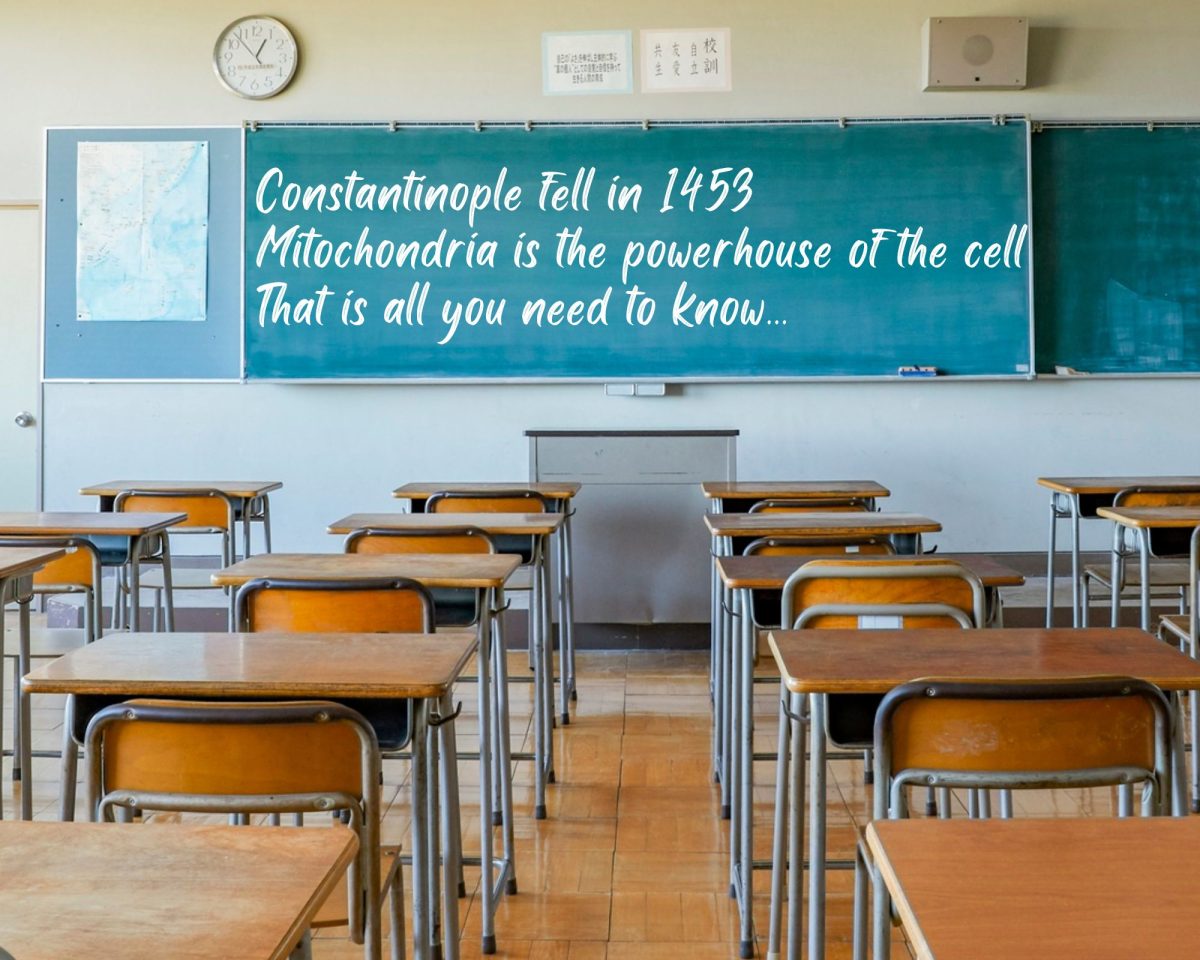
The Industrial Revolution was a booming time for society, and that included education. More and more people entered the education system and started attending universities. From 1785 until 1897, the traditional grading system was formed to quickly calculate quantitative data. Despite its efficiency, it does not accurately reflect students’ intelligence. The problem arises when schools try to accurately depict students’ intelligence if not all subjects are objective and grading standards vary from teacher to teacher.
Students today are tested and valued on their ability to retain and quickly recall massive amounts of information. The pressure of the tick-tick-tick of the clock reminds each student that every circle determines your entire future. It isn’t about the knowledge they know. It’s about the skill they possess.
English is a prime example of subjectivity. Poems, novels and excerpts can be interpreted in many ways; there is never one right answer. The art of writing is to invoke emotion in the reader through critical thinking or imagination. It is meant to resonate or entertain. Holding such a diverse and creative subject to such small boundary limits expansive creativity. This loss of open-endedness can cause some students to lose interest as it is “boring.”
Instead of a drooling student, one engaging in a discussion about the author’s writing could be more beneficial. A class discussion about something invoking and stimulating encourages students to learn and deepens understanding of complex situations. It introduces new thoughts and ideas. Discussions open a wide range of new perspectives that could contribute to real-life situations more than a sheet of paper for annotations and tests on literary knowledge.
Additionally, instead of emphasizing how to win the race against the clock for the day, it’s important to emphasize a full circle understanding of topics. A complex and deep understanding of math, language, social studies and science is important not only for individual development but also for societal development. If education focused on true understanding and learning, students would be happier and perform better. Students would also enter the real world more prepared.
Imagine a world where, instead of grading students and basing them on grades, it is more important to provide students with a well-rounded education. An education developed in understanding and discussion develops more complex ideas. A populace entering the world better educated than ever before world drive meaningful change and crucial development. That is more meaningful than how quickly someone can tell you the mitochondria is the powerhouse of the cell or that Constantinople fell in 1453. It should be why, with a shovel in hand, ready to dig to find out.